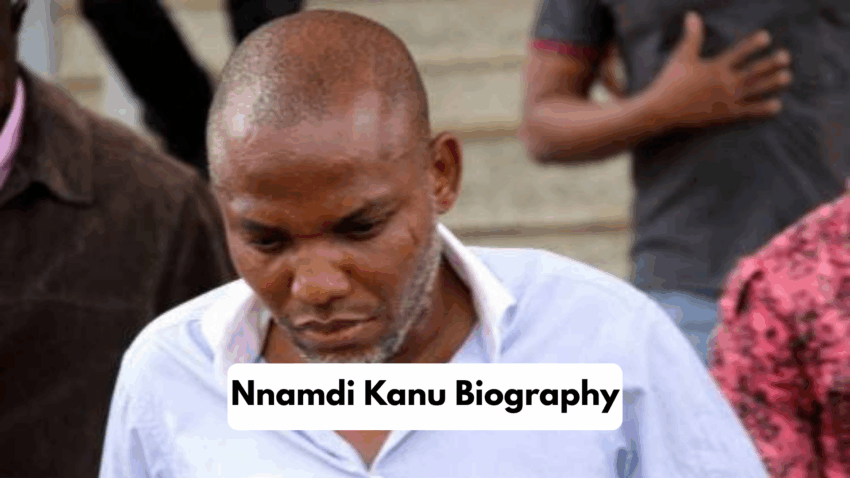
Nnamdi Okwu Kanu is one of the most controversial and influential political activists in modern Nigeria. As the leader of the Indigenous People of Biafra (IPOB), he has championed the cause of Biafran separatism, calling for independence for the southeastern region of Nigeria.
His activism, legal battles, and strong ideology have made him a polarizing figure. This biography delves into his early life, education, activism, controversies, and legacy.
Early Life and Background
Nnamdi Kanu was born on 25 September 1967 in Isiama Afara-Ukwu, Umuahia, in Abia State, Nigeria, into a royal Igbo family. His parents, Eze Israel Okwu Kanu and Ugoeze Nnenne Kanu, were traditional monarchs in their community, instilling in him a strong sense of identity and cultural pride from a young age. He attended Library Avenue Primary School before proceeding to Government College, Umuahia for his secondary education. Later, he enrolled at the University of Nigeria, Nsukka (UNN), though some sources suggest he left Nigeria before completing his degree and moved to the United Kingdom.
Education & Intellectual Growth
In the UK, Kanu continued to build his intellectual foundation, studying political science and economics, which would shape his worldview and inform his future activism. His education and personal experiences helped him articulate a vision of self-determination, which eventually translated into his leadership of a broader political movement.
Rise to Activism: Radio Biafra & IPOB
Radio Biafra
One of Kanu’s earliest and most powerful platforms was Radio Biafra, a London-registered station that he directed. Through the radio, he broadcasted messages calling for the restoration of Biafra — the defunct state that had existed during Nigeria’s civil war (1967–1970). Radio Biafra became a rallying point for many in the southeastern region and among the diaspora.
Founding IPOB
In 2012 (or around that period), Kanu founded the Indigenous People of Biafra (IPOB), a movement whose primary aim is to advocate for the independence of Biafra through self-determination. IPOB has since grown into a major socio-political force, with many followers in Nigeria and abroad.
Ideology and Beliefs
Kanu is deeply rooted in his Igbo heritage, but his beliefs also mingle Judaism into his identity. In court appearances, he often wore a Jewish prayer shawl (tallit) and head covering, and he has publicly stated that he “believes in Judaism.” This religious dimension has helped him frame part of his struggle in spiritual terms, resonating with certain audiences who see his fight as both political and religious.
On the political side, he criticizes what he perceives as systemic marginalization of the Igbo people by the Nigerian federal government. He argues for the right of self-governance and autonomy, seeing Biafran secession not as an act of violence but as a legitimate demand for self-determination.
Arrests, Legal Battles, and Controversies
First Arrest and Bail
Kanu’s activism brought him into frequent conflict with Nigerian authorities. On 14 October 2015, he was arrested by Nigeria’s Department of State Services (DSS) on charges that included treason, intimidation, and membership in an illegal organization. His arrest sparked major protests among IPOB supporters, many of whom saw him as a martyr for the Biafran cause.
In April 2017, Kanu was granted bail under strict conditions. However, tensions escalated when the military conducted a raid on his family home in Umuahia. This operation, sometimes referred to as “Operation Python Dance,” was fraught with violence, and Kanu subsequently disappeared from public view.
Disappearance and Rendition
After his disappearance in 2017, rumors swirled about his whereabouts. Some sources claimed he fled to Israel, and later to the UK. Then, in a controversial turn of events, he was reportedly rearrested in Kenya in 2021 and extradited back to Nigeria. There has been significant debate about whether his extradition was lawful, with allegations of “extraordinary rendition” leveled by his supporters.
Ongoing Trial & Conviction
Kanu’s legal struggles have continued for years. As of recent updates, he has faced multiple charges, including terrorism and treason. In November 2025, a Nigerian court sentenced him to life imprisonment on terrorism-related charges. The trial has seen several delays, changes of judges, and fierce public scrutiny.
His conviction has sparked both celebration among his critics and alarm among his supporters, who argue that his incarceration further marginalizes the Igbo people and stifles the Biafran cause.
Personal Life
Kanu is married to Uchechi Okwu Kanu, and they have a son, Nnabuikem Kanu. His family has largely remained supportive, even in the face of his prolonged legal battle.
His parents, Eze Israel and Ugoeze Nnenne Kanu, passed away in 2020. Their deaths were deeply felt within the Biafran movement; they had been pillars of support for their son’s cause.
Impact & Legacy
Nnamdi Kanu’s influence extends far beyond his legal battles. Through IPOB, he has revived conversations about the federal structure of Nigeria, ethnic identity, and self-governance. His activism has mobilized many Igbos — both in Nigeria and the diaspora — who feel neglected or oppressed by the central government.
To supporters, he is a freedom fighter and voice of justice. To critics, he is a separatist whose methods risk destabilizing Nigeria. Regardless of one’s view, it’s clear that his role in Nigerian politics remains significant.
His ability to combine political activism with spiritual messaging — particularly his embrace of Judaism — gives his movement a unique character.
Challenges and Criticisms
- Violent Rhetoric: In some speeches, he has made statements about the need for arms.
- Legal Scrutiny: His extradition from Kenya and subsequent trial in Nigeria has drawn international skepticism.
- Accusations of Extremism: The Nigerian government has repeatedly labeled IPOB a “terrorist organization.”
- Internal Movement Disputes: Some within the Biafran movement argue that IPOB under Kanu is too centralized; others say his strategies are too confrontational.
Current Status (as of 2025)
- Imprisoned for Life: In November 2025, Kanu was sentenced to life in prison on terrorism-related charges.
- Movement Impact: IPOB continues to operate, though leadership dynamics may shift in light of his incarceration.
- International Attention: His trial, detention, and human rights implications remain under international scrutiny.
FAQs (Frequently Asked Questions)
Who is Nnamdi Kanu?
Nnamdi Kanu is a British-Nigerian political activist and leader of IPOB, a group advocating for the independence of Biafra.
When and where was he born?
He was born on 25 September 1967 in Isiama Afara-Ukwu, Umuahia, Abia State, Nigeria.
What is IPOB?
IPOB stands for the Indigenous People of Biafra, an organization founded by Kanu to campaign for Biafran self-determination.
What is Radio Biafra?
Radio Biafra is a London-based radio station run by Kanu, used to broadcast pro-Biafra messages.
Has Kanu been arrested?
Yes. He was first arrested in Nigeria in 2015, disappeared in 2017, then was rearrested in Kenya in 2021 and extradited to Nigeria.
What was his sentence?
In November 2025, he was sentenced to life imprisonment on terrorism-related charges.
What are his beliefs?
He identifies with Judaism, often wearing a Jewish prayer shawl in court, and frames his fight as both political and spiritual.
Conclusion
Nnamdi Okwu Kanu remains one of the most influential and divisive figures in Nigeria’s modern history. He is both a symbol of aspiration for many southeastern Nigerians yearning for self-determination, and a cautionary figure to those wary of separatist movements.
His journey—from a young Igbo royal, to a radio broadcaster in London, to a jailed separatist leader—reflects the complex interplay of identity, politics, and justice in Nigeria. Whether viewed as a freedom fighter or a threat to national unity, Kanu’s life and legacy are indelibly tied to the ongoing debate over Biafran aspirations and Nigeria’s future.