Early life and background
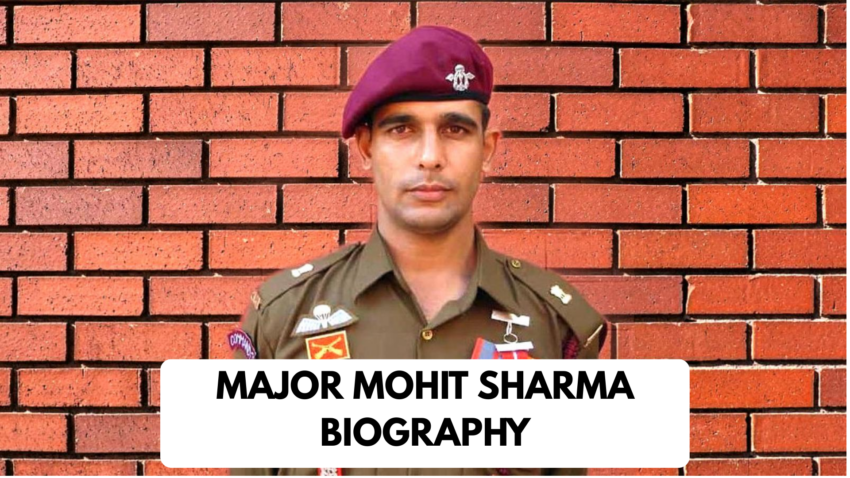
Mohit Sharma was born on 13 January 1978 in Rohtak district, Haryana. Raised in a family that valued service and discipline, he pursued a path that led him toward a military career from a young age. After schooling, he joined the National Defence Academy and later the Indian Military Academy, where his leadership and dedication became evident.
Joining the Indian Army and choice of Special Forces
Commissioned into the Indian Army in 1999, Sharma opted for the elite Para (Special Forces) in December 2002 and completed commando training to become a Para commando. Known among colleagues for his physical toughness, tactical skills, and calm under pressure, he quickly became a valuable member of 1 Para (Special Forces). During his service he also took on instructional roles, training the next generation of commandos.
Distinctions and earlier awards
Before the action that made him a household name, Major Mohit Sharma had already earned gallantry recognition. He received a COAS Commendation for outstanding counter-insurgency duties and was awarded the Sena Medal for a covert operation in 2005 — acknowledgments of repeated bravery and excellence in high-risk operations.
The Kupwara operation — the day of reckoning
On 21 March 2009, in the dense Haphruda forest of Kupwara in Jammu & Kashmir, intelligence indicated an infiltration and imminent terrorist activity. Major Mohit Sharma led a Bravo Assault Team to intercept the terrorists. During the encounter, insurgents opened heavy fire from multiple directions, critically wounding several of his men in the initial burst. Under intense enemy fire, Major Sharma crawled forward, extricated and rescued two wounded commandos, and returned to press the assault. During the action he eliminated multiple terrorists before succumbing to fatal gunshot wounds. His actions that day were marked by conspicuous gallantry, leadership under fire, and the highest standards of soldiering.
Posthumous honors: Ashoka Chakra
For his supreme sacrifice and extraordinary bravery in the Kupwara operation, Major Mohit Sharma was posthumously awarded the Ashoka Chakra — India’s highest peacetime military decoration conferred for valor, courageous action or self-sacrifice away from the battlefield. The award recognized not just a single moment of heroism but a career of selfless service to the nation.
Leadership and soldierly qualities
Peers and commanders described Sharma as a calm, focused leader who led from the front. He combined technical skill as a special forces operator with a protective instinct toward subordinates — repeatedly risking his own life to save his men. Those traits underpin the legacy he left in Para (SF) training routines and tactical thinking in small-unit counterinsurgency work.
Legacy beyond the uniform
Beyond medals and citations, Major Mohit Sharma’s legacy is visible in memorials and public remembrances. His story continues to inspire new recruits and serves as a case study in dedication, courage and the ethics of service. In recent years his name has been referenced in public discourse and media portrayals, and institutions have been renamed in his honor to preserve his memory.
How Major Mohit Sharma is remembered today
His martyrdom is commemorated by the armed forces and veteran communities. The courage he displayed is taught as an example in leadership courses and anecdotes about his rescue of wounded comrades are often retold to illustrate selflessness under fire. His life story underscores why many young Indians see the armed forces as a calling that demands honor, courage and sacrifice.
Frequently Asked Questions (FAQs)
Who was Major Mohit Sharma?
Major Mohit Sharma was an officer of India’s Para (Special Forces) who was posthumously awarded the Ashoka Chakra for gallantry after an operation in Kupwara on 21 March 2009.
When and where was Major Mohit Sharma born?
He was born on 13 January 1978 in Rohtak district, Haryana, India.
What unit did he serve with?
He served with 1 Para (Special Forces) — one of the Indian Army’s elite commando units.
What awards did he receive?
Major Mohit Sharma was awarded the Sena Medal (during his lifetime) and posthumously the Ashoka Chakra, India’s highest peacetime gallantry award.
What happened during the Kupwara operation?
In March 2009, during a forested encounter in the Kupwara sector, Major Sharma rescued wounded comrades under fire and neutralized multiple terrorists before succumbing to his injuries. He was later awarded the Ashoka Chakra for his gallantry.
How is his legacy preserved?
Through official gallantry records, memorials, renamed public sites, stories in military teaching, and recognition by veteran and public institutions. His life remains a source of inspiration for many.
Conclusion
Major Mohit Sharma’s biography is more than a chronicle of dates and decorations. It is a study in leadership, self-sacrifice, and unwavering commitment to comrades and country. From his early days in Haryana to elite training and ultimate sacrifice in Kupwara, his life exemplifies the highest virtues of military service. Remembering him is not just about honoring one soldier — it’s about keeping alive the values he stood for: courage, duty, and the protection of others even at the cost of one’s own life.