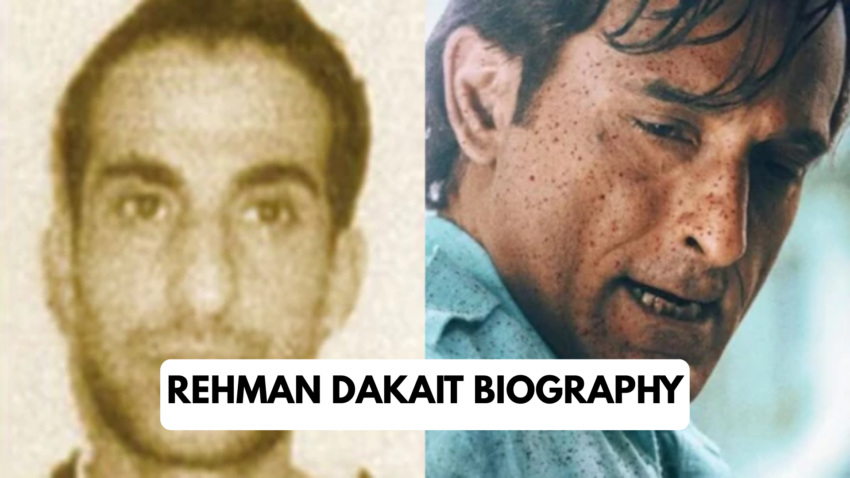
Sardar Abdul Rehman Baloch, more widely known as Rehman Dakait, is one of Karachi’s most infamous underworld figures of the 1990s–2000s. Rising from Lyari — a densely packed neighbourhood long associated with both rich culture and violent gang rivalries — Rehman Dakait became a local powerbroker whose life story mixes crime, politics and controversy. This biography traces his early life, climb to power, criminal activities, political connections, death, and the way popular culture has since portrayed him.
Early life and background
Rehman was born Sardar Abdul Rehman Baloch in Lyari, Karachi, in the mid-1970s (sources list 1975 as a common estimate). He came from a family already exposed to smuggling and street-based crime — his father and paternal uncle were reportedly involved in drug smuggling since the 1960s. Growing up inside this environment, Rehman’s path into petty crime and drug peddling began at a very young age. Local accounts suggest violent acts in his teens and a rapid escalation into organized criminal activity as he approached adulthood.
Rise within Lyari’s underworld
By the late 1990s and early 2000s, Rehman had consolidated influence in Lyari. After the arrest or weakening of previous local leaders, he reportedly assumed leadership of a gang that exercised control over extortion, drug distribution, illegal arms sales and kidnapping in parts of Karachi. Lyari — with its tight communities and complex local politics — became the stage where rivalries between gangs (notably between Rehman’s faction and rivals like Arshad Pappu’s group) repeatedly exploded into violent confrontations. Journalistic profiles from the region describe a “kingdom of fear” where gang rule shaped daily life for many residents.
Criminal activities and allegations
Rehman Dakait’s alleged criminal portfolio included extortion, kidnapping, drug trafficking and running organized violence against rival gangs. Some accounts also attribute extreme acts of brutality to him; these include highly sensationalized allegations that appear in multiple media retrospectives and are frequently restated when the subject resurfaces in public conversation. It’s important to treat some of the more lurid claims as reported allegations drawn from investigative journalism and police records rather than uncontested facts.
Peoples’ Aman Committee and politics
At the height of his power, Rehman was associated with a group known locally as the Peoples’ Aman Committee. Reports suggest the committee operated in the grey zone between community control and political muscle — a structure some described as a gang-turned-local-committee that also had connections to mainstream political currents in Sindh. The interface between criminal leadership and politics in Karachi has long been a delicate, disputed subject; observers point out how local strongmen sometimes developed ties with political parties or local officials to shield or expand their operations.
Death and aftermath
Rehman Dakait was killed in a police encounter in Steel Town, Karachi, on 9 August 2009. His death ended the most visible chapter of his criminal career but did not mark the end of the broader gang networks: successors — most notably Uzair Baloch in later years — continued to shape Lyari’s criminal and political landscape. Official accounts and later reflections by journalists and local figures painted his death as both the collapse of an era and a trigger for new struggles over control in Lyari.
Reputation, contested narratives, and how history remembers him
Rehman’s life is one of those local histories that can be read many ways. For residents who suffered under gang violence, he remains a symbol of intimidation. For others — especially in politically charged narratives — he has sometimes been portrayed as a local strongman who offered order (albeit violent and criminal) in neighborhoods abandoned by state services. Journalists cautioned readers to separate myth from verifiable fact: Lyari’s story is tangled with politics, poverty, and the security dynamics of Karachi at the turn of the century.
In popular culture
Interest in Rehman Dakait surged again when filmmakers and writers drew on Lyari’s history. In 2025, the Bollywood film Dhurandhar featured a character inspired by Rehman (portrayed by actor Akshaye Khanna), which reopened discussion about the real man behind the myth and sparked renewed media profiles that summarized his life and crimes for new audiences. These portrayals have added layers to public memory — blending dramatized visuals with journalistic accounts — increasing both curiosity and controversy around his story.
Legacy and lessons
The Rehman Dakait story matters beyond one person. It’s a window into:
- How marginalization and poverty can create fertile ground for criminal organizations.
- The complex (and sometimes corrosive) relationship between politics and street power in urban Pakistan.
- The challenges of policing, justice, and community rebuilding after cycles of gang violence.
Understanding Lyari’s history — not just the sensational headlines — helps explain why criminal leaders can arise and what structural reforms are necessary to prevent their return.
Frequently Asked Questions (FAQs)
Q: When and where was Rehman Dakait born?
A: Sources commonly list his birth year as around 1975 and his birthplace as Lyari, Karachi.
Q: What crimes was he accused of?
A: He was accused of organizing extortion, drug trafficking, kidnappings and violent attacks against rivals. Some extreme allegations (widely reported in media) should be read as reported claims rather than uncontested facts.
Q: Did he have political connections?
A: Rehman and the group associated with him (Peoples’ Aman Committee) operated in a space that intersected with local politics. Accounts vary on the exact nature and depth of political ties, but observers note that political-clan dynamics in Sindh helped shape local power structures.
Q: When did he die and how?
A: He died on 9 August 2009 in a police encounter in Steel Town, Karachi.
Q: Has he been portrayed in films or books?
A: Yes — his life inspired media portrayals, including the 2025 Bollywood film Dhurandhar where a character based on Rehman was depicted on screen. These dramatizations reignited public interest in his story.
Conclusion
Rehman Dakait’s biography is not simply the biography of one man; it’s a snapshot of a troubled urban history — where poverty, politics and weak institutions combined to create spaces for violent actors to thrive. While his life invites sensational headlines, it’s the deeper structural questions — how communities recover, how local governance can be strengthened, and how criminal patronage networks are dismantled — that remain the most important takeaways. For readers curious about modern Karachi, Lyari’s story and Rehman Dakait’s role within it are necessary pieces in a much larger puzzle.